Friday, May 27, 2011

Ice-forecasting Project Uses Facebook to Improve Safety for Walrus Hunters and Whalers

The Sea Ice for Walrus Outlook (SIWO), an activity of the SEARCH Sea Ice Outlook started in 2010, is a resource for Alaska Native subsistence hunters, coastal communities, and others interested in sea ice and walrus. The SIWO provides weekly reports from April through June with information on sea ice conditions relevant to walrus in the Northern Bering Sea and southern Chukchi Sea regions of Alaska.

Excerpts from the Article:

Marine mammal hunters trying to negotiate increasingly finicky ice conditions have a new ally: a National Weather Service project that can shoot weather forecasts and satellite imagery straight to their cell phones.
The idea for the project came from Vera Metcalf, executive director of the Eskimo Walrus Commission. The project allows hunters experiencing climate change first-hand to inform scientists and each other about what they're seeing, such as the thickness and movement of ice, said Metcalf.

The satellite images span several miles off the coast of each village, but aren't detailed enough to allow hunters to spot animals.
To learn more and read the entire article and associated links: The Arctic Sounder
To visit the Facebook page for Sea Ice for Walrus Outlook (SIWO): SIWO Facebook

Friday, May 6, 2011

Choosing Your Big Game Hunting Knife


Choosing and purchasing your big game hunting knife can be a fun task with just a little research and consideration beforehand. I am the first to admit I like knives and have purchased far too many over the years. Those purchases were usually based on wanting to have something different to try as opposed to really being in need of something new. I am not a knife collector so all of my knives have a history of assigned duties and are not relegated to a display area or stored in my safe.  Not that there is anything wrong with collecting knives. I just can't afford another hobby!

There are many factors that should be considered before you lay down your hard earned money on a blade. Probably the first area of concern should be to decide what your working price range is likely to be.  You may find that to be the easiest component of your quest for the perfect knife, if such a thing even exists.
Choosing your preferred hunting knife will come down to how you intend to use it, preferred platform configuration, blade material, blade shape and length, sharpening and edge holding characteristics, handle material, balance, cosmetic preference, and as mentioned previously the cost factor.

Once you have established if you are able and willing to spend, $50.00, $150.00, $500.00, or $5,000.00 you can start down the path of other selection concerns. This is probably as good of place as any to say that I understand fully that specialty knives can be used for each area of big game hunting chores. Likewise, general configurations can also be chosen to optimize performance over a variety of areas in most instances thus reducing the number of blades one carries with them on an outing. Neither approach is right or wrong just two different ways to get to the same destination. The next area of consideration after price is likely to be choosing a construction platform.
Knife platforms generally fall into two main categories which are fixed blade or folding.  There are also hybrid categories such as the flip blades and the interchangeable blade systems. The sales pitch for these is of course a multi-functional knife approach. If you like those as options a little research will provide a variety of considerations in various price ranges.

In the interest of full disclosure, I have not used or tried the replaceable blade or flip blade knives that are on the market. For me personally, they are not a knife that interests me. They may however be exactly what you are looking for making it the perfect choice for your purchase so they should not be discounted as an option.
I have used the more traditional folding knives and fixed blade configurations for hunting.  While I own both types I have come to prefer a fixed blade hunting knife.  For me, there is no other platform to consider when it comes to big game applications. This does not mean it is the correct choice for you it is simply what I prefer. My basis for convincing myself this is the right choice for me is reliability, ease of cleaning, maintenance, and design strength.

Folding knives are an attractive option for those looking for a multi-purpose knife that will be utilized for hunting but will also be carried for everyday use as well. For most people a fixed blade knife will not perform that function as well as a folding knife simply because they are larger and are carried in a sheath. A fixed blade sheath generally extends downward and can often get in the way of everyday chores, chairs, and vehicle seats. They also tend to stand out with daily wear clothing. The other plus to a folding knife is it is often more compact and offers more carry options. These would include carrying a folder in your pant or jacket pocket or even in a small sheath on your belt.  The folding knife sheath is generally much shorter than a fixed blade sheath. Attention should always be given to assure the folding knife has a locking feature to assure the blade does not close accidentally while in use. The pivot area of the blade should also be examined to assure it is robust to help eliminate, as much as possible, any inherent weakness of a pivoting area.
How you intend to use your knife will to a large degree help to determine blade size and configuration. I generally bone meat where allowed and find that I can also break down and skin big game animals in the field easily and efficiently with a 4” blade. A larger blade is not needed by me for this type of task. This size blade works perfectly in performing caping chores as well and is why it is my most preferred knife in a clip point blade design.

I do not like serrated blades on big game hunting knives and avoid them in my selections. I have used 4” clip point blades on game ranging from javelina to moose without issue. I offer this as background information in case you experience difficulty in deciding on blade length and configuration.
The main blade types available include clip point, drop point, and skinning profiles. Modified versions of these three basic designs are also available. The clip point blade is the style you likely will remember seeing on the Bowie knife. When looking at a clip point blade from the side you will notice the blade tip appears slightly upswept but the main feature is the concave area on the front portion of the blade spine that leads to the knife point. This is a good all around blade in my experience and is the one I generally prefer in most instances. It works very well in performing field dressing, skinning, boning, and caping duties. The sharp tip of the clip point blade allows you to get into tight places when caping such as the tear ducts, around antler bases, and also when detailing the face.

Top knife shows a serrated blade section. Middle knife is a drop point. Bottom knife displays a clip point profile
Drop point blades are recognized by a convex area on the front portion of the blade spine that leads to the knife point. This makes the knife point less defined when compared with a clip point blade. This is also a versatile design with regard to field dressing and skinning.  It falls short on performing caping duties in my experience and is therefore less desirable for my needs when the goal is to pick a one knife does-it-all blade design.

Skinning blades are recognized by their curved trailing point when viewing the blade from the side. The blade tip noticeably curves upward and the spine of the knife curves upward. This gives the blades working surface a larger belly for skinning. This blade configuration is more specialized but can efficiently field dress and really shines in the skinning department.  It does not however offer the general characteristics you would usually want when performing caping duties.

There are of course other blade configurations besides the three previously listed. These include spey point, spear point, needle point (dagger style), and sheepsfoot blades. While they have a niche they are however not generally considered as general purpose hunting blades.

Gut hook style blade with a drop point
Choosing blade composition is a consideration when making your purchase. You will in general have two broad categories from which to choose. There are also hybrids such as ceramic or modern Damascus steel (pattern welded carbon steel or Damascene) blades.  Choices for most knives will normally be either carbon steel or stainless steel as an option.  Some manufacturers will offer you the same knife model in either blade composition choice.
I am not a bladesmith and don’t want to impart that I have a great understanding of metallurgy. The Rockwell hardness of a knife blade is typically between RHC 56-62. Blades that have a content of greater than 13% chromium are normally considered stainless steel. Quality knife manufacturers use a variety of steels ranging from carbon material like 1095, CPM M-4, A2, O1, D2 and stainless steels such as 154 CM, 440B, and N680.  Many other types of steel are also utilized.
Higher amounts of carbon in steel increases hardness while a higher amount of chromium improves corrosion resistance, wear, and hardenability. Regardless of the material utilized heat treating is what helps to further develop the blades properties. Each steel material does of course have its own inherent properties such as hardenability, ductility, and toughness.

I have used various blades made from stainless and carbon steel and can offer an anecdotal level of information. In general, carbon steel and stainless steel blades each have their advantages.  Stainless steel of course is less prone to rusting while carbon steel blades will rust more easily. That in and of itself is not a problem it just means you must be aware and give your carbon steel blade a little more attention.
Stainless might be a better choice for those who will primarily use their knife in snowy, wet, or humid environments but especially so for those who frequent saltwater environments. Blades that are made of high carbon steel are often said to hone more easily and hold a better edge. I have found both stainless and carbon blades that have worked very well for my intended use.

If you just remember to treat your carbon steel blades like a blued steel hunting rifle they will serve you well.  Things like cleaning your blade thoroughly after use, drying the blade, storing it in a dry location, and applying a wax such as Renaissance ® as opposed to oiling the blade. Waxing a stainless steel blade is also a good idea. Bolster, guard, and pommel luster can be restored by polishing with a product such as Simichrome® from time to time and can also be waxed. When storing your knife it should not be left in the sheath.
Handle material is an important consideration for a working knife. For my way of thinking a big game knife should have a handle material that is easy to clean and maintain. Exotic wood looks very pretty but I generally lean toward the phenolic resin, rubberized material, bone, or stag handles. I find these wash up well and are very durable in my experience. One thing that I particularly like about the rubberized material is when you add blood to the equation the knife remains very controllable.  This is also true when the knife becomes wet from rain or snow.

Top knife is a Randall that shows a curved blade compared with a Buck Woodsman 102 clip point (bottom)
Hopefully this will give you some food for thought before making your big game knife purchase.  Don’t worry too much because if you are like me you will most likely want to try something different before too long. What is my favorite knife?  I love my Randall Model 4 and also my Knives of Alaska Bush Camp for various chores. The knife that has seen more use on big game than any other continues to be my Buck Woodsman 102. It does it all and has never let me down. It goes to show you that you do not have to spend a lot of money to find a quality knife that will fill your big game needs.

Wednesday, April 27, 2011

DVD Video Clips for Mark Sullivan, Craig Boddington, Ivan Carter & Others

Diizche Safari Adventures has recently updated their Website DVD page and associated their current DVD offerings with video clips! Visit their DVD landing page to learn more about DVDs being offered. Let us know if you like the idea of being able to preview DVD excerpts.

Saturday, March 5, 2011

Hiking Boots and Foot Comfort

Choosing the right boot is one of the most important decisions you will make when it comes to mountain hunting. Unfortunately, it is not as simple as doing an internet search for product reviews and picking the one with the most stars. Although admittedly, there can be some value in this as a potential starting point. Online reviews are often very useful to learn if a particular boot is prone to certain characteristics or problems. What fits one person well will not likely fit the next so trying boots on is of course a necessity to properly compare brands that will work best for you.  
Make a short sighted decision in your quest for the proper boot and you will likely be miserable, in pain, and not very efficient as your hunt progresses from day one to day fourteen. Mountain hunters require the very best in support and durability. As such, you will likely require a durable boot exterior and sole that won’t get eaten up by rocks and shale.  A high rubber rand is also helpful. The boots will also need to support heavier pack loads, especially coming off the mountain with your hard won reward.
There are many nuances to getting your preferred boots to feel just right if the out of box fit is a little less than perfect.  Here are three very important components that some might tend to overlook.  These include proper sock selection, aftermarket insole selection, and learning variables in lacing techniques. Knowing how to utilize various lacing techniques will also help you to fine tune your boots as needed during any given adventure.
When purchasing new boots, the factory insoles often feel perfectly acceptable. If that is the case for you consider yourself lucky.  Many of us find the need for various levels of support because of our different arch height requirements, the need for additional support, better foot control in the heel cup, or more forefoot padding.  The goal of aftermarket insoles is of course proper biomechanical alignment, comfort, reduction of shock, and improved foot control.
Regarding insoles, some shoppers can afford to seek out custom-made orthotic insoles but many are quite satisfied using trim to fit or heat-moldable insoles.  The heat-moldable varieties will of course create a more custom do-it-yourself approach specifically molded to your foot.  The only problem is you can’t try them on to see if you like how they feel before you buy them.  You will need to make the investment and hopefully they will provide what you need. There is nothing wrong with this approach but it is an aspect to consider before you buy. 
The trim to fit variety of insoles can be inserted into your specific boot and trialed at your local shop that carries the brand or brands that are of interest to you.  My local REI shop happens to have a selection of trial models that they allow customers to slip in their boots and test drive in the store.  It offers a great way to compare brands and models within brand lines to see what feels best! I am sure this is available through other outdoor shops as well.
Once you find the trim to fit insole that feels the best, purchase one pair and take them home. You will then need to remove your factory insole and trim the replacement insole following their supplied instructions. Once they are trimmed, you can insert them into your boots and start using them on your training hikes. If they work well, I would recommend purchasing an additional pair, trim them to fit and keep them with you as a rotational pair on your hunts.
Annually, I put a minimum of fifteen miles per week on my boots rain or shine during my mountain training hikes.  This does not include actual hunting. It is easy to forget at times but insoles do not last forever. Replace them regularly to help assure you keep your feet as happy as they can be made to be. Recently, I noticed my feet were getting a little sore during my hikes for no apparent reason.  I inspected my insoles and noticed they were in need of replacement.  I had not changed them for about 12 months.  For me, that was a little too long.  Everyone’s mileage and timelines will of course vary based on use. When you consider all the costs associated with your outdoor hunting adventures, regularly replacing insoles is not even on the radar as a cost concern.
This is probably as good a place as any for a short word or two about socks. They are not all created equal from your foot’s perspective. Don’t be afraid to try different thicknesses and of course different fabrics such as wool, high tech fabrics, or blends to see what works best for your needs.
There are many methods for lacing a boot. I am surprised by the number of people who spend a great deal of time outdoors in boots and are simply unaware of these techniques and what can be achieved. If a standard lacing method works for you then that is great!  If you think there is a possible benefit to be gained with lacing and knot variations, give a few different techniques a try and see how your feet feel about it.  Now you know why those boots of yours came with such long laces!
When you lace your boots the goal is generally to create even firm pressure from the lace to the boot surface creating a secure and firm foundation while avoiding overtightening. Lacing technique options may vary slightly based upon the overall eyelet style of your boot or eyelet style in different sections of the boot.  These would include variations such as regular eyelets, D-loop, lugs, and other speed laces. 
There are seemingly unlimited variations of lacing techniques and knots but starting with just a few can offer a lot of versatility in properly adjusting or securing your boots. By learning and using simple lock, tension, and knot techniques you can then customize to suit your specific needs. It used to be that to learn these techniques you had to pick the brain of savvy climbers. That was how I first learned a few basic techniques. With access to the internet, all this information is easily available to all from the comfort of their home.
When using unmodified lacing, the laces typically come up from below and under the boot eyelets. When switching to a locking technique you can either continue from the bottom of the eyelet or come around and down through the eyelet to apply pressure to the lace. This can then be followed with an overhand knot or a surgeon's knot interval where needed to secure the tension you have adjusted through the eyelets below the knot. I prefer using the surgeon’s knot as it locks extremely well. Locking techniques are very useful in stabilizing your foot without the need to create unnecessary amounts of pressure through the laces.

Heel Lock Technique

A boot heel lock technique is useful to help maintain pressure in such a way as to keep your heel and foot in place.  This can be accomplished easily by taking the lace along the outside of two hooks, as opposed to crossing the lace at each hook, and then bring the lace back down over the upper of the two hooks hooks and passing the lace free end under the opposite straight lace created between the hooks, pulling with tension and then going up to the next highest hook resuming a normal lace crossing technique. Variations of this technique can be utilized such as an overhand or surgeon’s knots along with a loop locks. 

Loop Lock Technique Used to Help Adjust a Low Volume Situation 

A loop lock is typically created by going over a hook as opposed to coming up from the bottom of the hook and then crossing the laces and going to the next hook. This will create a loop around the hook. I find this technique is useful if I choose to wear a thinner sock which then creates a lower foot volume condition inside of my boot. This technique helps to comfortably take up that space created by the thinner sock.

Reducing Pressure on a High Instep

You can reduce pressure over your instep by locking off tension with a surgeon’s knot, then skip the lace crossing technique where the boot would bend naturally over the instep hooks, and then again lock off tension with an overhand or surgeon's knot above this area. This creates a larger open area free of crossing laces over the instep which will be noticed as a reduced amount of pressure.
Most finish their boot with a square knot and avoid a granny knot which is said to often slip. Those that double knot are sometimes less concerned about a granny knot. There are some variations you can consider prior to the finishing knot. Cuff pressure can be controlled at the top of the boot by lacing over the top of the final hook and tying off below the hook.  You can also adjust cuff pressure by using a normal hook approach at the top and adding a surgeon's knot prior to the final knot. An alternate method for boots with a top eyelet is to create a loop lock through the eyelet prior to the final knot. I generally finish my lacing with a surgeon’s knot topped with a modified double knot. This gives me a secure non-slipping knot that is easily untied with a simple pull of a lace end.

Finished with a Double Knot Over a Surgeon's Knot
If you are interested in learning more about knot and lacing techniques there are numerous sites that you can visit through an internet search. Keep in mind that some lacing techniques are nothing more than a way to add flash or style.  You will likely want to focus on learning the techniques that will offer performance enhancements and adjustability gains.

Wednesday, March 2, 2011

Education Fund for the Children of Slain PH Andre de Kock

By now, most in the hunting community have learned of the tragic death of Professional Hunter Andre de Kock, reported as killed by poachers in Tanzania (read reported information). The Robin Hurt Foundation, together with Conservation Force has set up a fund of Andre and Lesley de Kock for their two children Mathew and Kelly. Conservation Force is a 501(c) (3) public charity and all donations are tax deductible.

If you are interested in helping, you can make a donation online at: http://www.conservationforce.org/donateonline.html- select de Kock Family Fund from the contribution type.
Lastly, for those of you in Africa (because of the high transfer fees) you may contact Michael Angelides for information regarding making donations from your country at secretary@tzpha.com .

When giving your donation through this non-electronic method please provide your
full name, contact details, address and email. All the names will be given to
Conservation Force who will acknowledge your individual donation (required by
law).


For more information regarding the fund contact Conservation Force:
Chrissie Jackson - cjackson@conservationforce.org 

Wednesday, February 9, 2011

Trekking Poles-Why Bother?


I remember the first time I started to prepare for a mountain hunt and began entertaining the idea of utilizing trekking poles.  Initially, I was hesitant to even consider their use but kept hearing of the potential benefits.  I was skeptical at first and when I first started using them I absolutely hated them and thought they were nothing more than an awkward irritating distraction. 


I stuck with them on my training hikes and eventually learned to become more comfortable with their presence as I put more miles on them from week to week.   That was a long time ago.  Now I never even notice I have them with me as they have become more of an extension of my body while both ascending and descending trails.  They offer great stability and allow one to move quickly over rough terrain and they really help to lighten the strain and load of a pack in steep country. 


So what are trekking poles all about and why would you want to be bothered with these while hunting?  Let’s take a look at some things to consider and perhaps you might want to ponder their use as well.  First off, I must state that they do leave marks on rocks as you move about ascending and descending trails.  That little carbide or steel tip holds on for traction and will definitely leave a scratch behind.  For those of you who are of the mindset that chewing up a trail by leaving marks is a non-starter I submit for consideration that in most areas a few additional marks on rocks are likely no worse than the actual trail itself you’re moving along.  There is a small rubber tip protector or walking tip which you can add to cover the carbide tip for more sensitive areas to reduce damage to terrain.  You can also help to reduce damage to vegetation that is immediately off trail by keeping your pole tips on the trail where possible.  When not on a trail you can consider not using the poles on flat terrain to minimize soil and plant damage and only using the poles during ascent, descent, or for a difficult traverse.


Let’s explore some advantages to utilizing trekking poles.  As I mentioned, they help to offer stability and balance by allowing you to have additional points of contact as you move along terrain.  This benefit is realized through contact with the ground or rocks where you are traveling as well as when leaning around obstacles or moving through more difficult terrain.  They are also very helpful in this department when going over or under obstacles with your pack mounted.


If you are moving over loose terrain, icy areas, snow patches, wet slippery rocks, or through streams they help to make the passage feel much safer and easier to negotiate with confidence.   You will definitely notice a feeling of improved footing and stability.  They are also handy to test soft or boggy areas as you find so often in areas of Alaska.  Trekking poles generally come with a smaller trekking basket that is visible just above the pole tip.  If you desire, this basket can be replaced with a larger snow basket for use in the snow and on soft, muddy terrain.
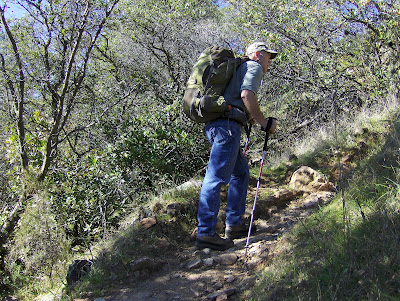


When ascending with a pack they really reduce tired legs as you can push with the pole to thrust or push yourself upward.  By doing this you are transferring some of your weight to your back, shoulders, and arms.  I have a disability that involves my lower back and dominant wrist.  The use of trekking poles really helps me to continue what I enjoy doing outdoors and to stay fit and prepared for my next adventure. 

Correct Strap Entry from the Bottom

Incorrect Strap Entry from the Top

It is worth mentioning that when you use the trekking poles the strap is what receives much of the strain of ascent and descent and not your hands.  Padded or lined straps are beneficial and will help to reduce rubbing and chafing.  If you are death gripping the poles for stability, unless specifically needed for a certain terrain situation, you are likely using them incorrectly.  To use the straps correctly you must insert your hand up through the bottom of the strap and not through the top of the strap.  This allows the strap to work properly.  Having straps that are adjustable is a real plus.  This feature will allow you to tighten or loosen the straps as needed and allows for a more precise fit when adding or removing gloves in different environmental conditions.


On trail descent they are great in decreasing stress that would ordinarily be absorbed primarily by your legs, knees, and ankles.  I have read that the percentage of reduced compressive force to the knees can be as much as 25%.  If that figure is accurate, it is pretty significant when you consider those day long or multiday descents with equipment and game over the course of a long trail.


There is of course no such thing as a free lunch.  The reduction of stress and strain to the legs and knees is going to be felt in the arms and other areas to some extent.  What is occurring is a redistribution of how the weight or stress is distributed to your body parts.  When you first start using trekking poles you may notice fatigue in the shoulders and upper arms and neck.  I know I certainly did.  For me, this diminished over time with regular training as these newly taxed muscles strengthened.


One of the first and obvious considerations, if you are a rifle or bowhunter that plans on utilizing trekking poles, is the need to get the rifle or bow out of your hands to allow you to use the poles.  You will need to consider various weapon carry methods to remedy this issue.  For me, I like the Kifaru GunBearer® system but there are other systems and packs specifically designed to fulfill this performance requirement for both rifle and bowhunters.


There are a variety of trekking poles available but for this discussion I am focusing on the aluminum trekking poles that most have seen and have familiarity.  I have not had personal experience with Nordic walking poles or hiking staffs and do not feel qualified to offer opinion without first giving them a try and directly comparing their performance and benefits.  In rugged hunting environments aluminum poles get my nod over carbon fiber poles which are of course lighter.  Aluminum can bend but is less likely to experience a failure and break.  A carbon fiber pole would be more vulnerable to the possibility of splintering or perhaps breaking when compared to aluminum under high stress in rugged mountain terrain situations.  That would be a very uncomfortable situation at best and potentially a very dangerous situation should it occur on descent with a loaded pack and weight bearing on a pole trying to negotiate a problem area of a trail.    


Many trekking pole models are available for both men and women.  Brands include Leki, Komperdell, and Black Diamond to name just a few.  Manufacturers include features such as compact poles, which are shorter and have a smaller grip for those who have smaller hands such as women.  As the name implies, antishock poles work to absorb shock.  These antishock systems can consist of springs, air valves, and rubberized components.  Different manufacturers take different approaches to achieving shock absorption systems.  Some systems, such as spring assisted systems, can be turned off during an ascent. 

Grip Material and Ergonomics for Consideration


Poles are also available in a standard configuration without a shock system.  There are also various grip materials and grip angles available, ultralite aluminum and even carbon versions, as previously mentioned.  Once you decide that a trekking pole might be in your future it is a great idea to arm yourself with a little online research regarding model variations.  Mentally take that information with you and pay a visit to your local climbing shop or outdoor retailer to get your hands on various models to see how they feel to you. 
Using Extended Grip Area During Traverse
Because of my wrist and back problems the antishock system is what I opted to utilize.  My hunting partner is always focused on ounces saved and for him the only choice was a lightweight aluminum model with ergonomic angled cork handles.  It is worth mentioning that when you look at trekking poles you may notice that some will have an extended grip below the main grip.  This is useful in very steep terrain where you may need to negotiate a rough area and choke-up on the pole in a specific area of the climb or traverse.  Handles are generally available in rubber, foam, or cork.  Each has a realized benefit and therefore a potential drawback in some situations.  Rubber insulates and reduces shock.  It can also cause a blister in hotter weather if you don’t have on a lightweight glove.  Cork conforms well to the hand and resists sweat well.  Foam is very soft but absorbs moisture more easily.


When you shop, weight, strength, and price will be factors to consider along with handle material and ergonomics.  There are also different locking mechanisms such as DuoLock (Komperdell), Super Lock (Leki), and FlickLock (Black Diamond).  These systems all work to provide a dependable system to help assure secure settings.  The systems are proprietary and vary from manufacturer.  I personally chose Black Diamond as I found I liked the ease of making adjustments on the fly with gloves on and the adjustability of controlling the lock-up pressure through the FlipLock.  I also liked their antishock system.  Your preference may vary and you should handle different systems to see what you like best.


I would recommend that you speak with someone knowledgeable at your local outdoor shop to help you set-up your pole length initially and give you a few pointers on pole placement and length adjustments in various terrain.  It is not rocket science but a few tips before you get started can really help to shorten the learning curve.  You also want to assure that the pole you are considering will be correct for your height and allow for adequate pole extension during descents. 


In general, when on a level floor, you will adjust your poles so that your forearm is parallel to the floor while you hold the grips and the pole tip is touching the floor.  This length adjustment should be made between the top and bottom sections of the trekking pole to allow adequate section extension capability of the upper section for descents.  Once you have the level ground adjustment figured out, simply note the markings on the upper and lower section and commit those to memory.  Those settings will likely work well in varied terrain (gentle up and down trails) and level areas.  I tend to also use this setting for ascents as well.  You can also shorten the poles a couple of inches on ascents if you prefer.  When descending, you will lengthen your poles a few inches to provide the necessary length to reach out below you and gain balance.  I usually use a default adjustment of an additional 20 cm for typical descents that I find works well for me.

Marking Poles for Ascent and Descent


Because I am forgetful at times, I marked my poles with a permanent marker to denote my permanent bottom pole setting, which I do not adjust, and also marked my two upper pole settings which I typically use for either a normal/ascent situation or the extended position for a steep descent.  This makes for a quick easy adjustment while on the trail without trying to put glasses on to read numbers and get things just right.  When I compress my poles to make them compact for transportation, it is a quick and easy adjustment to get them right where I like them to be the next time I hit the trail.  When you find yourself in a traverse situation in steep terrain you can either shorten the uphill pole manually or if your pole has the extended grip area, simply hold the pole in the area below the main grip.


There are a few other uses for your trekking poles should you decide to add poles to your outdoor equipment list.  First, they can serve as an improvised rest or to stabilize a peek through the binoculars.  Some tents will allow for the use of a trekking pole as the tent support pole allowing you to dump the tent pole and keep that extra weight out of your pack.   A trekking pole also works well to raise a tarp for a quick improvised shelter and can also be used as a splint or a crutch.  Finally, it is a great place to wrap extra electrical tape if you use that for bore protection on your firearm and prefer not to wrap extra tape around your barrel.


I have learned to fully appreciate the benefits of using trekking poles in mountain environments.  Poles have now become a part of my general equipment list for that reason.  If you have a friend who uses them, have him/her give you a quick lesson and give them a try.  Remember to be patient and to allow yourself some training time to learn how to manipulate the poles, adjust them for different terrain, and use them in various applications.  Once you learn how much they can help with a load you will understand why so many mountain hunters would never be caught without them!   


Wednesday, January 12, 2011

Some Basic Global Positioning System Considerations


Global Positioning System (GPS) technology for hunting and outdoor navigation is a wonderful tool to use as primary navigation or as a layer of redundancy along with other navigation tools such as your general orientation/awareness, topographic paper maps, compass, and Lat/Long or UTM scales.
A GPS unit can naturally be used alone to navigate back to a particular starting point or to a pre-saved location without the use of other supporting equipment.  If you need to travel to a specific location on a map by first plotting and reading the position coordinates from the map and then using the GPS to navigate, then some supporting items, such as those previously mentioned, would be useful.  By referring to a map, I mean a hardcopy as opposed to a GPS loaded topographic map.
GPS users have varying levels of experience and needs but for many, using the more basic functions are all that is often needed.  These basic functions might consist of just initializing the GPS unit, saving and naming a waypoint, and of course using the go to feature.     
I have had the opportunity to utilize many different brands of both handheld as well as consol mounted marine GPS units.  There are many excellent brands available.  What can make some units standout over others are various features such as being waterproof, having electronic compasses, barometric altimeters, color displays, built-in basemaps, data card capability, and optional map software capability. 
Other areas for comparison of GPS units might include the number of waypoints, routes, and tracks allowed within the track log.  If all this sounds confusing, remember that many of these areas for comparison purposes are not necessarily the most important areas for concern. 
One of the most important variables when comparing GPS receivers is how well they receive and lock-on to satellites and then hold that lock when moving through tree cover, brush, or canyons.  In my opinion, the GPS unit that comes with an abundance of features is not much more useful than being a weight on a throw cord to keep your food away from bears if it can’t lock and hold satellites in difficult terrain.  When comparing units, note the number of channels that the unit can track simultaneously, accuracy is an important performance consideration, and external antennas are also a valuable option for units that will be used in situations where open sky is limited.
When I hunt with friends, we frequently compare our GPS units side by side while moving through dense foliage and heavy canopy to better understand which units are performing better than others.  All GPS units are not created equal in their ability to acquire and hold satellites.  When you start researching and comparing GPS units to replace an older model, make certain that you scrutinize product evaluations and note the models of units that lock and hold those satellites the best. 
I have replaced my GPS units many times over the years and have always been happy with the upgrades in performance or additional features gained with the replacement unit.   My current GPS is the Garmin GPSMAP®60CSX.  I have been very happy with this unit’s performance in the most difficult of terrain.  Eventually something will probably come along that I will like better but for now this is just what I need.  Remember to practice with your unit on your training hikes and it might also be helpful to bring along a copy of the units field guide as you learn all the features that are important to you.