Friday, June 10, 2016

HEYM: Special Model Mark Sullivan Double Rifle

(Click Each Photo to Enlarge)
Spending time with a friend is always a joy. Even more so when your friend shares your passion for doubles and hunting dangerous game up close! This week I was able to visit with my good friend Mark and share my custom HEYM double rifle. Mark was working on one of his own .577 NE doubles so we decided to meet at our mutual friend's home not far from the San Francisco Bay Area to share some stories and compare some notes.

I originally placed my order to build this HEYM rifle when we were both in Germany assisting on the range during a HEYM shooting event. The rifle would be built and delivered during the HEYM 150 Year Anniversary. While placing my order, I selected the wood for the build and tailored several custom options while at the factory. We received this fantastic custom built HEYM about 7 months ago from Germany. 


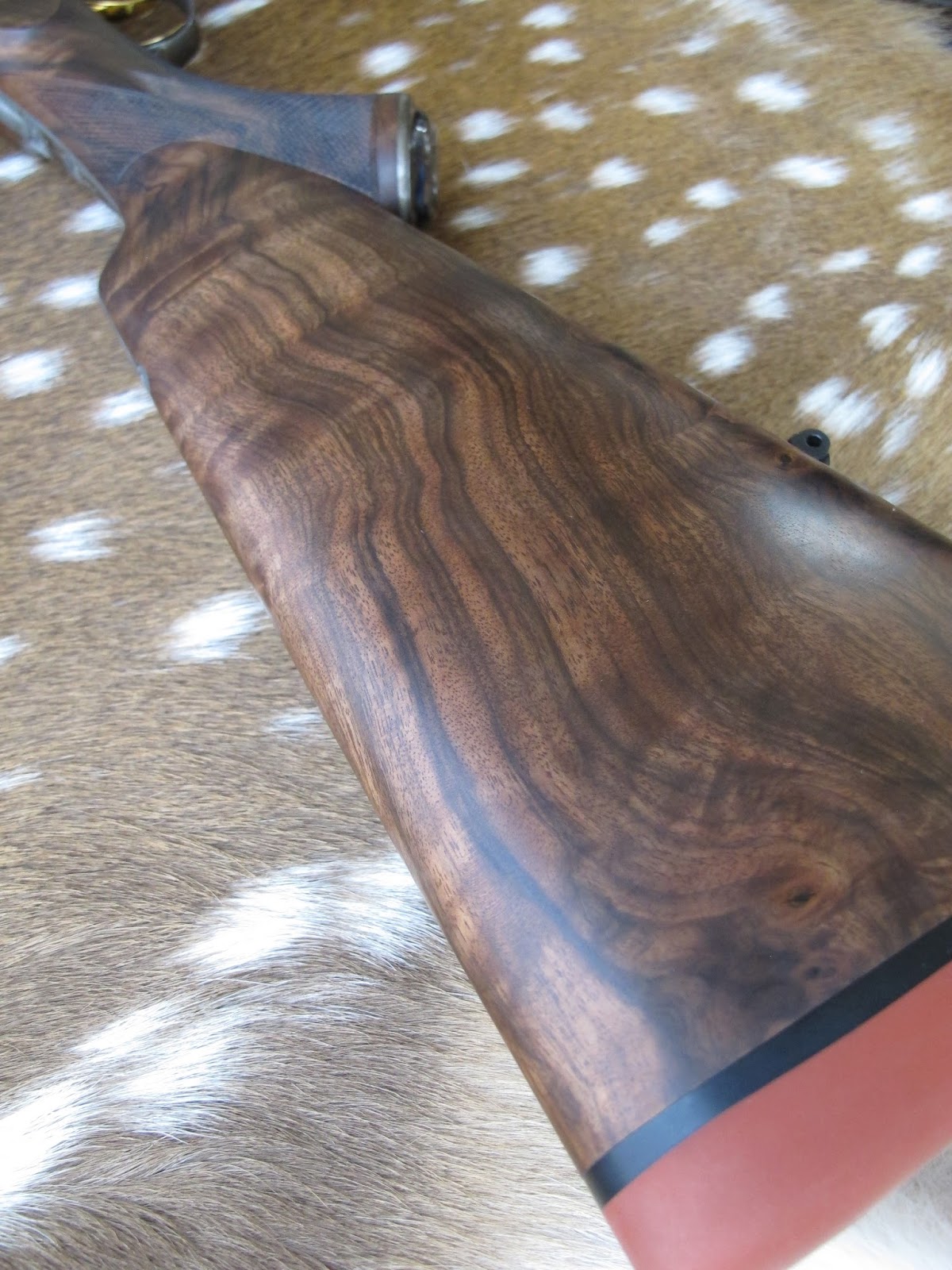
This particular model is a HEYM best quality boxlock in .577 NE known as the Special Model Mark Sullivan. The base configuration of the receiver is the Model 88B Large Frame boxlock. Some of the features that I particular like are the special 1920s Holland & Holland stock design (in upgraded European Walnut I selected while in DE) that is very comfortable, handles fabulously, and fits me very well. It has a narrow pistol grip circumference by design, optimized overall weight (12 pounds 5 oz. in this configuration with 23 7/8” barrels).

Standard features are also present such as Krupp Steel/cold hammer-forged barrels manufactured by HEYM in house, A&D (Anson & Deeley-style with coil springs) boxlock with triple lock-up (Purdey double underbite with Greener cross-bolt), bolstered frame, articulated front trigger, automatic ejectors, and intercepting sears. The rifle is hand fitted, assembled, and regulated for proper function, accuracy, and reliability.

As you can see in the pictures, it also has the extended top tang, extended bottom tang to the pistol grip cap, special safety as designed by Mark, Silver’s recoil pad, single screw pistol grip cap, shallow “V” rear sight with gold line, and traditional ivory flip-up front night sight for low-light.

Since Mark was instrumental in the design and development of this double we wanted to go over it together. We spent time handling the rifle and of course pouring over all the details. We also had our Holland & Holland double handy for comparative points of reference just in case they were needed. Our consensus and the consensus of those with us was that HEYM got it right and did a fabulous job on this Special Model Mark Sullivan!

Here are a few pictures that highlight some of the features:


A quick public thank you to Thomas Wolkmann, all of the great craftsmen and specialists at HEYM DE and also to Chris Sells and his staff at HEYM USA. Additional thanks to Büchsenmachermeister (master gunsmith) Rico Stephan of HEYM DE for regulating this great rifle. The professionals at HEYM never disappoint! I greatly appreciate your assistance, professional perspective, craftsmanship, and of course attention to detail.

Special thanks regarding the beautiful finishing touches. The hand engraving was done by Michael Oke from Münnerstadt. Conrad Recknagel in Suhl completed the case color hardening in the traditional way of "bones and charcoal" treatment. 

I am making plans with Mark so we can spend some time together again in Tanzania up close with buffalo and hippo. The right place and the perfect hunts for this great double rifle!


Sunday, April 17, 2016

Help Spread the Truth About Saving Lions

Photo from the Independent - (independent.co.uk)
The truth about hunting and sustainable use of lions is often on the wrong side of public opinion. It is difficult for people to grasp the connection between hunting and conservation of species. The reality is that lion populations are increasing or stable in countries where lion hunting occurs. Habitat loss and loss of prey – primarily in western and central Africa where hunting typically does not occur – are the main sources of population declines for African lions, not hunting. 

The more the public knows about the benefits of hunting programs, the less likely it is that governments will be influenced by the misinformed (or ill-intentioned) public. For the truth about lion hunting and the benefits of sustainable-use conservation visit http://www.fightingforlions.org.

Wednesday, April 13, 2016

IUCN Releases Briefing Paper on the Benefits of Trophy Hunting


The International Union for Conservation of Nature (IUCN) released a briefing paper this month that serves to educate European decision makers and the public on the benefits of trophy hunting. The Dallas Safari Club (DSC) has commended the IUCN for their brief on trophy hunting and stated:

DSC applauds the International Union for Conservation of Nature (IUCN) on a report that educates European decision makers and the public on the benefits of trophy hunting.

An IUCN briefing published this month discusses in great detail how legal, well-regulated trophy hunting can and does generate critically needed incentives and revenue in order for government, private and community landowners to maintain and restore wildlife as a land use and to carry out conservation actions, including much-needed anti-poaching interventions.

Recently, a few cases of poorly regulated and poorly conducted hunts have brought about increased concern for trophy hunting. Confusion and misinformation have led to knee-jerk reactions and, in some cases, blanket bans on hunting and transportation of hunting trophies.

A group of members of the European Parliament have called for the signing of a declaration to ban imports of trophies. IUCN urges that their findings be incorporated into any discussions calling for partial or full bans on trophy importations. IUCN’s findings show the widespread benefits resulting from trophy hunting and provide scientific research as a basis for policy decisions.

“As a member of IUCN since 2015, DSC is pleased to see the IUCN’s findings align with our mission to better inform those in charge of making decisions and implementing policies that can forever affect our natural resources,” said DSC Executive Director Ben Carter. “We support science-based decision making − not emotion-based − and the IUCN’s findings demonstrate how trophy hunting not only improves wildlife populations and habitat but also the surrounding communities.”

The facts listed in the brief vividly illustrate the increased wildlife populations, the increased habitat and the improved livelihoods of surrounding communities brought about by trophy hunting revenues. Restrictions on importation of trophies can make trophy hunting programs economically unviable at local levels. This loss of local and national revenue may remove incentives for entities to properly manage and protect wildlife and would likely cause serious declines in populations of a number of threatened or iconic species.

Monday, April 11, 2016

Another Fine Example of Conservation through Sustainable and Ethical Hunting


Spreading the word about how poaching is damaging to wildlife conservation is an important topic. This article contains content about commercial poaching and displays pictures that some viewers may find disturbing or offensive. If you are under the age of 18, if such material offends you or if it is illegal to view such material in your community please do not read this article. Please use discretion.

Prior to 2002, Coutada 9, like all other wilderness areas in Mozambique, had been through over 25 years of civil war and rampant poaching. This massive area (4333 square kilometers) was left virtually devoid of wildlife. Furthermore, the area suffered serious habitat destruction, being subjected to annual late season bushfires and the indiscriminate cutting of trees through “slash and burn” agricultural practices. In 2002, Rio Save Safaris (made up of Mokore Safaris, Western Safaris and Gajogo Safaris), took over the concession and set out to rehabilitate the area to its former glory. First, they needed to take control of the massive poaching epidemic and provide surface water for the very limited remaining wildlife.

Over the past 13 years RSS has drilled 22 boreholes and constructed 12 large dams, these provide permanent surface water for the wildlife in Coutada 9. This water is essential for life and all species benefit, including birds, smaller mammals as well as insects. The construction of these dams has been a lengthy and expensive exercise.


Some of the completed dams on Coutada 9 creating permanent surface water for the wildlife.

Since 2003 RSS anti-poaching teams have consistently removed over 1000 gin traps per year, caught on average 150 poacher per year and confiscated numerous homemade muzzle loader rifles as well as a few modern assault weapons like AK 47’s from poachers. For EVERY weapon confiscated, poacher apprehended or trap removed RSS have paid an incentive bonus to the anti-poaching units. Due to these continuous efforts, the wildlife has thrived and flourished, to the stage where most populations have reached sustainable population densities.


A year’s haul of traps and guns with some of RSS anti-poaching game scouts.

Elephants are poisoned by villagers where nothing from the animal was utilized. Most poaching is done for commercial use and totally unsustainable.

Some species populations, however were so low that RSS set out to re-introduce these species. Not a small feat in itself considering no importation of wildlife or inter-area game transfers had ever taken place in Mozambique. After 18 months of tireless negotiations, RSS imported 10 lions in September 2009 from Phinda Game Reserve in South Africa. They were transported and successfully released into Coutada 9 over 1600 km away. 
The lions were only put in quarantine boma for 3 weeks to settle before being released into Coutada 9. They have settled and are breeding well in the Coutada.


Waterbuck numbers, a species that once thrived in Coutada 9, were down to a mere handful after the civil war. RSS made a deal with Gorongosa National Park to swap 20 Zebra and 40 eland for 146 waterbuck. GNP got to increase their eland and zebra populations and C9 received 146 waterbuck in September 2013. Waterbuck are now seen daily and breeding well.


Eland from Coutada 9 being released into Gorongosa National Park and
the replacement of 146 Waterbuck into C9.
The capture team at work. 
A key priority from the outset, was to boost the local remnant buffalo population and after more than 10 years of trying to source buffalo from surrounding countries as well as within Mozambique RSS was FINALLY granted permission from the Mozambique government to capture 50 buffalo as a trial from the Zambesi Delta reserve. This was finally achieved in 2015. The 50 buffalo were put in quarantine boma initially and are safe and sound in Coutada 9 with plans now to capture a further 250 next year. The 50 buffalo we introduced last year cost RSS over US$75,000.00 not to mention the many frustrating years trying to get permits to do this project.


The first 50 buffalo in their quarantine bomas, November 2015.
These projects and all other developments such as building of road networks, Safari Camps and staff accommodation to date have been funded through trophy hunting. RSS operates on a strict sustainable off-take quota where a small percentage, normally 2-5% of a population, is harvested. These animals are usually males past their prime and their removal has little impact on the overall species population.

All funds raised through trophy hunting to date, have gone back into the conservation and development of this magnificent area as well as to support the local communities. 


RSS employ 50 game scouts for anti-poaching alone as well as another 60 plus people for all other development work required. This in turn provides over 100 families with a reliable source of income and food annually.

Of the animals harvested 25 % of the trophy fee received from foreign hunters goes directly to the local communities. RSS also supplies most meat to the community either directly through delivering it to the local villages or indirectly through issuing it to the staff working within the Coutada. The meat from ALL animals harvested is FULLY utilized, including lions, baboons and especially elephant.


RSS has also built a school, clinic and drilled boreholes for the surrounding communities. Many of our hunting clients have made donations to the school personally or in the form of delivering SCI Blue Bags.

Poaching, as opposed to legal trophy hunting, is indiscriminate, without regard to age, sex or species of animals killed. There is no respect for boundaries or numbers of animals harvested and if not constantly policed there WILL be no wildlife left. The general modus operandi of the poachers in this region is hunting with homemade gin traps or snares which is very cruel. When RSS initially arrived in Coutada 9 almost every animal harvested by hunters was missing a foot from these traps.

Basically, the animal once trapped will drag the trap around for 3 -4 days until the poachers catch up to it and kill it with an axe or spear. Some species such as lion, buffalo, leopard and elephant that they cannot kill due to the danger aspect with their axes are left to drag these traps around for weeks until the animal dies either from starvation or from infection. Sometimes the animal’s foot rots, breaks or is bitten off. These survivors are then crippled for life, or slowly lose condition and die.


One male lion had three of its four limbs injured from traps. Thanks to hunter supported anti-poaching efforts there are far fewer cases of injured animals but still a massive and continual problem.


An eland with a trap on that escaped the poachers with two axes embedded in it and a baby elephant that had to be put down after dragging this trap for over a week and another that eventually died from infection and starvation.


A buffalo cow that was caught in a trap that was put down after a week, as was the kudu, one of several elephant poached annually for their ivory and a buffalo bull shot with a trap on it.


A mature lioness and a sub-adult lioness that both died from these traps.


A young male lion that was caught with a trap, after a week its foot rotted off and is now walking around with only 3 feet.


The illegal cutting of hardwoods for planking is another massive problem and the RSS anti-poaching team is heavily involved in trying to protect all the beautiful hardwoods on Coutada 9.

The only donations received to date have been from the hunting organizations, Dallas Safari Club and Safari Club International. RSS would like to thank them both for helping us save the animals and habitat on Coutada 9.

A massive THANK YOU to all the hunters who in following their passion for adventure in wild Africa have saved thousands of animals in Coutada 9, provided employment and income for many families as well as fed thousands of local villagers over the past 13 years. None of the animals pictured here have names but hunters are the ONLY ones fighting to save these remote and wonderful areas and their wildlife. Your continued support of sustainable hunting is greatly appreciated. D
ue to its location and topography many areas are totally unsuitable to photographic type tourism and thus would not generate the necessary funds to rejuvenate and protect these wild areas.


Pictured above is 1306 gin traps, 68 cable snares, 9 can rat traps and 25 homemade muzzle loaders that were collected by our RSS anti-poaching team in 2015 alone. This anti-poaching effort alone costs RSS over US$100,000.00 annually, all of this comes from sustainable hunting.

After 13 years of hard work Coutada 9 boasts one of the best game population densities in wild unfenced Africa today and will only improve since the addition of more waterbuck, lion and buffalo to the Coutada.